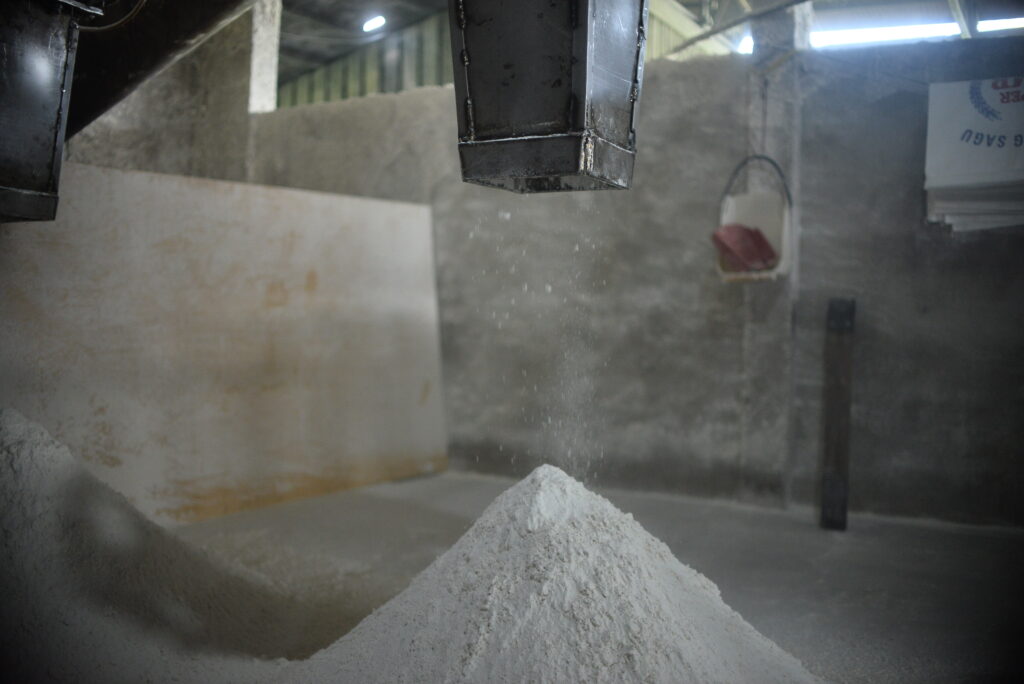
The Cheapest Sago Starch Factory Kuala lumpur
Sago strach is flour derived from the trunk of the sago palm tree. As a gluten-free flour alternative, sago flour is increasingly popular due to its smooth texture and health benefits when consumed appropriately.
Well, for those of you who are looking for the sago strach factory Kuala lumpur, please contact us immediately.
Optimal Harvesting Period of Sago Plants
Sago is a perennial plant that serves as an important food source, particularly in certain regions. Compared to other crops such as rice or maize, sago has a much longer harvesting period. This plant grows optimally in muddy areas with mineral-rich soil, high organic matter content, brown-colored groundwater, and slightly acidic pH levels.
In addition to its role as a food source, the sago plant offers numerous other benefits. Various parts of the plant—such as the leaves for roofing, the leaf sheaths for walls, and the bark for constructing sago walls—are widely used in daily life. In order to be utilized, however, the sago plant must first be harvested.
When Is the Sago Harvesting Period?
Sago plants require a relatively long time before they can be harvested, typically around 13 to 15 years after planting. At this stage, the plant exhibits several distinctive characteristics indicating that it is ready for harvest. These indicators include:
Changes in leaves and trunk: The last emerging leaves are more upright and smaller in size.
Slight swelling of the crown and reduced spines.
Flower formation: Before flowering occurs, flower primordia or buds begin to develop.
Stages of Sago Harvesting
Harvesting sago requires careful handling to produce high-quality starch. The main stages of the harvesting process are as follows:
- Area Cleaning: Clear the area around the plant of obstructive vegetation and moss attached to the sago trunk.
- Water Preparation: Select a clean location for pith extraction, usually in a river near the sago plantation.
- Trunk Cutting: Cut the sago trunk at a height of approximately 50–60 cm above the ground.
- Preparation of the Extraction Site: Set up a designated area for squeezing the pith and collecting the sago starch.
- Trunk Splitting: Split the trunk and remove the bark. Typically, the basal part of the trunk, about one meter in length, is processed.
- Pounding: Using a pounding tool, the sago pith is repeatedly crushed to produce fine pith fragments.
- Extraction: The crushed pith is mixed with water and squeezed using cloth to separate the starch (sago flour).
- Packaging of Sago Starch: The separated sago starch is placed into rice sacks or other containers for storage.
The lengthy process of harvesting and processing sago reflects the vital importance of this plant for communities that depend on it as a primary food resource. When carried out properly, sago can be utilized to its fullest potential, both for consumption and for various daily needs.
Get to know Eco Sago as the Largest Sago Strach Factory Kuala lumpur
Eco Sago is one of the cheapest sago flour factory in the world, ready to meet your sago flour needs for business and household purposes.
Located in Kuala lumpur, Meranti Islands—an area rich in sago resources—we are committed to producing high-quality sago flour.
Every stage, from tree harvesting, milling, to screening, is carried out meticulously to produce flour that is smooth, soft, and hygienic.

Eco sago adalah produsen tepung sagu terbesar di dunia dengan kualitas terbaik,
higienis dan teruji sertifikasi, Hadir untuk membuka peluang bisnis untuk anda.
CONTACT US

+62 896 8263 9377
Phone Number

Ecosagos@gmail.com

Makam, Selatpanjang, Riau
Alamat Pabrik 1
Merindang, Selatpanjang, Riau
Alamat Pabrik 2
Alamat Pabrik 2
Ruko Galaxy Baloi Blok A Nomor 4, Batam, Kepri
Kantor
Sertifikasi