Negeri Sembilan Sago Starch Industry for Keropok Lekor
Sago starch is flour derived from the trunk of the sago palm tree. As a gluten-free flour alternative, sago flour is increasingly popular due to its smooth texture and health benefits when consumed appropriately. Sago flour can be used as an ingredient for making keropok lekor.
Keropok Lekor a traditional Malay snack in the form of fish crackers typical of Terengganu, Malaysia, which are made from a mixture of fish (such as selayang or parang) and sago flour.
Keropok lekor which uses sago flour (not sweet potato/tapioca flour) is known to produce a chewier, softer texture and a more prominent fish taste.
Well, for those of you who are looking for the Negeri Sembilan sago starch industry for keropok lekor, please contact us immediately.
Food Consumption Patterns of Sago Plantation Farmers
Food consumption patterns can be understood as eating habits that reflect the types, quantities, and frequencies of food consumed by individuals or groups within a given period. In the General Guidelines for the Development of National Food Consumption, consumption patterns are defined as the average daily food composition per person, viewed in terms of both type and quantity.
A wide range of factors shape food consumption patterns, including economic conditions, education levels, cultural background, and the availability of food in a particular region. Social values and lifestyles also play an important role, and in some cases, considerations of prestige influence food choices. In addition, religion, knowledge, and food accessibility contribute significantly to household consumption decisions. To describe the consumption patterns of sago plantation farmers, studies are typically conducted through structured interviews with respondents in the field.
Research findings identify four main categories of community food consumption patterns:
- Reliance on sago as the sole food source.
- Consumption of a combination of sago, tubers, and bananas.
- Consumption of sago, tubers, bananas, and rice.
- Consumption of rice only.
Among these patterns, the combination of sago, tubers, bananas, and rice is the most dominant, accounting for 52 percent of respondents. The abundance of local food resources makes this pattern widely adopted, further supported by the continued availability of rice through the government’s rice assistance program for low-income households (raskin).
Approximately 16 percent of the population continues to rely on sago as a staple food, while 22 percent prefer a combination of sago, tubers, and bananas. This pattern is commonly found in rural communities, particularly among older generations who remain accustomed to local food sources. In contrast, about 10 percent of respondents—most of whom are irrigated rice farmers—consume rice exclusively. This is largely because they are less familiar with, or lack knowledge of, how to process sago, bananas, and tubers into daily meals.
Get to know Eco Sago as the Largest Negeri Sembilan Sago Starch Industry
Eco Sago is one of the cheapest sago flour factory in the world, ready to meet your sago flour needs for business and household purposes.
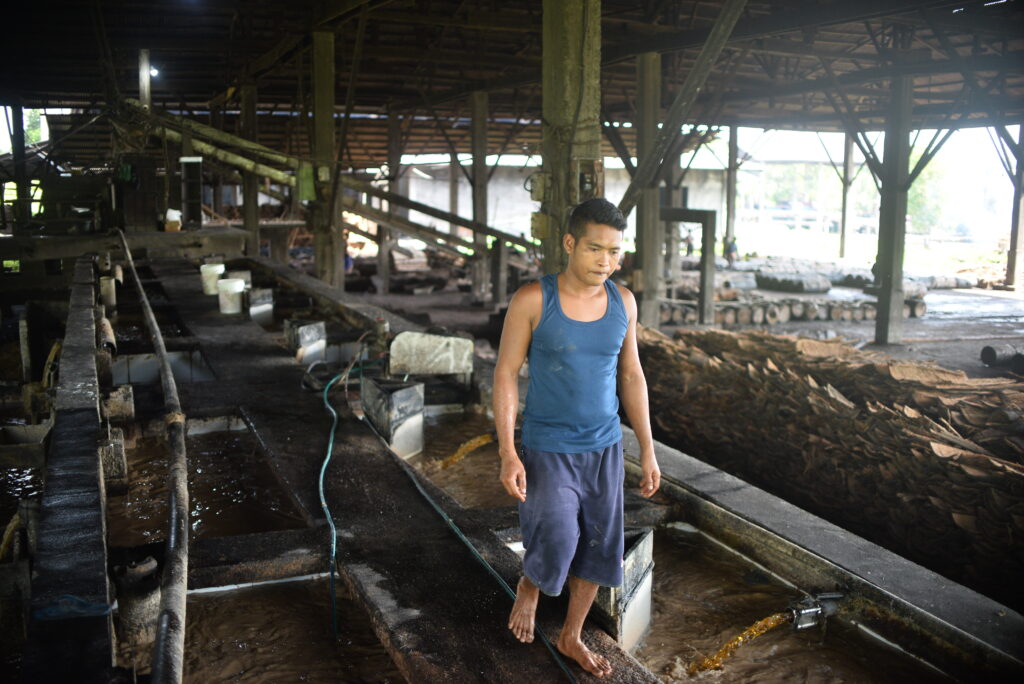
Located in Selatpanjang, Meranti Islands—an area rich in sago resources—we are committed to producing high-quality sago flour.
Every stage, from tree harvesting, milling, to screening, is carried out meticulously to produce flour that is smooth, soft, and hygienic.

Eco sago adalah produsen tepung sagu terbesar di dunia dengan kualitas terbaik,
higienis dan teruji sertifikasi, Hadir untuk membuka peluang bisnis untuk anda.
CONTACT US

+62 896 8263 9377
Phone Number

Ecosagos@gmail.com

Makam, Selatpanjang, Riau
Alamat Pabrik 1
Merindang, Selatpanjang, Riau
Alamat Pabrik 2
Alamat Pabrik 2
Ruko Galaxy Baloi Blok A Nomor 4, Batam, Kepri
Kantor
Sertifikasi