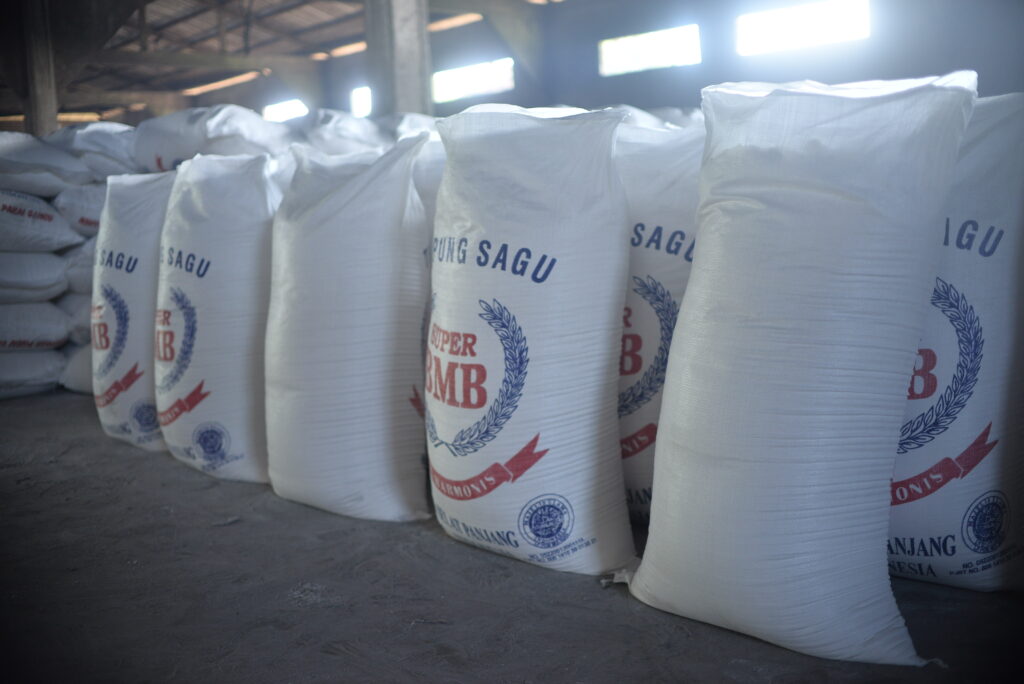
Kedah Sago Starch Supplier for Keropok Lekor
Sago starch is flour derived from the trunk of the sago palm tree. As a gluten-free flour alternative, sago flour is increasingly popular due to its smooth texture and health benefits when consumed appropriately. Sago flour can be used as an ingredient for making keropok lekor.
Keropok Lekor a traditional Malay snack in the form of fish crackers typical of Terengganu, Malaysia, which are made from a mixture of fish (such as selayang or parang) and sago flour.
Keropok lekor which uses sago flour (not sweet potato/tapioca flour) is known to produce a chewier, softer texture and a more prominent fish taste.
Well, for those of you who are looking for the Kedah sago strach Supplier for keropok lekor, please contact us immediately.
Structure and Composition of Sago Trunk and Pith
The sago trunk is the most essential part of the sago palm, as it serves as the primary source of starch. Its structure consists of a hard outer layer and a softer inner layer containing fibers and pith—the core section where large amounts of starch are stored. The outer bark is typically 3–5 cm thick, composed of dried leaf sheath residues, a thin reddish layer, a brown hardwood section, and the innermost pith, which is rich in starch.
The starch found within the pith is a complex carbohydrate made up of long-chain polysaccharides. For applications in the food industry and fermentation processes, these chains must first be broken down into simpler glucose molecules.
In terms of shape, the sago trunk is cylindrical, with a diameter ranging from 35 to 60 cm, depending on the plant’s age and environmental conditions. During its productive stage, between 3 and 11 years, the trunk can reach a height of 13–16 meters, and even up to 20 meters under optimal conditions. Each variety has its own distinct characteristics; for instance, Metroxylon rumpii is known for its large trunk at harvest age (9–11 years), while M. longispium generally has a smaller diameter throughout its growth stages.
The main factors influencing starch content include the plant variety, age, and soil quality. Generally, the older the sago palm, the higher its starch content. However, once the plant enters the flowering (generative) phase, the starch content decreases as most of the plant’s energy is redirected toward the development of flowers and seeds.
The pith of younger trunks is characterized by a fine texture, low fiber content, and small, translucent starch granules. In contrast, the pith of older trunks appears coarser, with larger granules, a slightly brownish color, and higher fiber content.
In traditional practices, sago trunks are typically felled and cut into sections measuring 2.5–3 meters in length. Each section is then split lengthwise using a machete or axe to extract the pith. However, once the trunk is opened, natural fermentation can occur rapidly. If not processed immediately, this fermentation can produce acidic compounds that reduce the quality of the starch.
By gaining a thorough understanding of the trunk structure and pith characteristics, sago can be utilized more efficiently—both as a staple food source and as a raw material for various derivative products.
Get to know Eco Sago as the Largest Kedah Sago Starch Supplier
Eco Sago is one of the cheapest sago flour factory in the world, ready to meet your sago flour needs for business and household purposes.
Located in Selatpanjang, Meranti Islands—an area rich in sago resources—we are committed to producing high-quality sago flour.
Every stage, from tree harvesting, milling, to screening, is carried out meticulously to produce flour that is smooth, soft, and hygienic.

Eco sago adalah produsen tepung sagu terbesar di dunia dengan kualitas terbaik,
higienis dan teruji sertifikasi, Hadir untuk membuka peluang bisnis untuk anda.
CONTACT US

+62 896 8263 9377
Phone Number

Ecosagos@gmail.com

Makam, Selatpanjang, Riau
Alamat Pabrik 1
Merindang, Selatpanjang, Riau
Alamat Pabrik 2
Alamat Pabrik 2
Ruko Galaxy Baloi Blok A Nomor 4, Batam, Kepri
Kantor
Sertifikasi