Selangor Sago Starch Supplier for Keropok Lekor
Sago starch is flour derived from the trunk of the sago palm tree. As a gluten-free flour alternative, sago flour is increasingly popular due to its smooth texture and health benefits when consumed appropriately. Sago flour can be used as an ingredient for making keropok lekor.
Keropok Lekor a traditional Malay snack in the form of fish crackers typical of Terengganu, Malaysia, which are made from a mixture of fish (such as selayang or parang) and sago flour.
Keropok lekor which uses sago flour (not sweet potato/tapioca flour) is known to produce a chewier, softer texture and a more prominent fish taste.
Well, for those of you who are looking for the Selangor sago strach Supplier for keropok lekor, please contact us immediately.
Key Differences Between the Sago Palm and the Sugar Palm
The Sago Palm
The sago palm (Metroxylon sagu) features long leaves resembling those of the coconut palm. Its central rachis runs along the middle, with leaflets arranged pinnately to the right and left, similar to the structure of a fishbone. Naturally, it thrives in humid lowland environments such as swamps, riverbanks, and wetlands that are generally unsuitable for other crops.
Its trunk is cylindrical and can grow up to 20 meters in height. The surface is often covered with remnants of dried leaf sheaths, and in some sections, aerial roots may develop. The leaves are large and extend outward, although some grow upright. The leaf stalks are armed with sharp spines similar to those of the salak palm, requiring caution during harvesting.
In addition to its starch-rich trunk, the sago palm produces round fruits resembling salak. The fruit has scaly skin similar to snakeskin; when young, it is green and astringent in taste, turning brown and sweeter as it ripens. Mature fruits typically fall naturally from the tree.
The Sugar Palm
In contrast, the sugar palm (Arenga pinnata) is more commonly found in upland areas, such as hillsides and mountainous regions. It is easily distinguishable among other tall trees due to its unique characteristics.
The trunk of the sugar palm is cylindrical, reaching heights of up to 20 meters with a diameter of approximately 40–50 centimeters. Its leaves resemble those of the sago palm in their pinnate arrangement; however, they differ in coloration—the upper surface is dark green, while the underside appears silvery.
A defining feature of the sugar palm is the thick black fiber enveloping its trunk, known as ijuk. This fiber serves numerous purposes, including roofing for traditional houses, brooms, ropes, and environmentally friendly composite materials due to its resistance to seawater.
The sugar palm also bears fruit distinct from that of the sago palm. Its fruit has smooth skin without scales, green when unripe and yellow when mature. After being processed—typically by boiling or roasting to remove sap—the seeds are extracted and become known as kolang-kaling, a popular ingredient in beverages and sweet desserts.
Flour Production Methods
For generations, particularly in eastern Indonesia, communities have relied on the sago palm as a staple food source. Since the 1970s, sago has gained recognition as a potential global carbohydrate source, drawing the attention of the Food and Agriculture Organization (FAO) in the 1980s, which conducted research in Indonesia and Papua New Guinea.
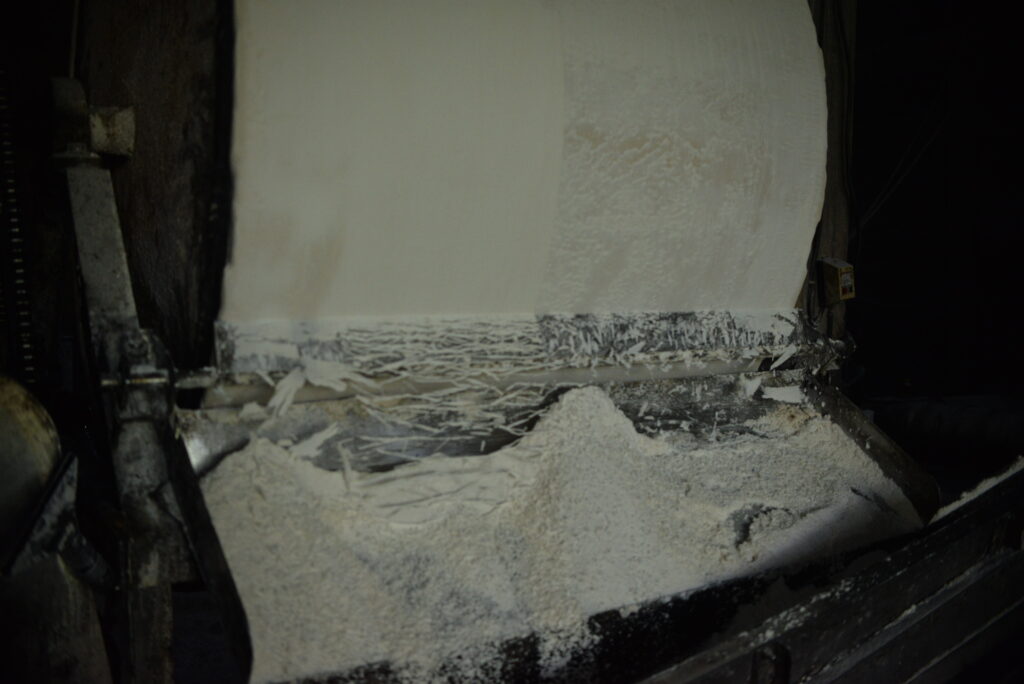
The traditional production of sago flour begins by felling a mature sago palm and removing its outer bark to access the starch-rich pith. The trunk is then chopped into small pieces, grated or crushed, and mixed with water to dissolve the starch. The liquid is filtered, allowed to settle, and subsequently dried to produce ready-to-use sago flour.
By contrast, sugar palm–based “sago flour” is not pure starch extracted from the trunk. Rather, it is typically a processed blend of sago flour and palm sugar. This combination produces a distinctive natural sweetness and is widely used as a base ingredient in various traditional Indonesian delicacies.
Get to know Eco Sago as the Largest Selangor Sago Starch Supplier
Eco Sago is one of the cheapest sago flour factory in the world, ready to meet your sago flour needs for business and household purposes.
Located in Selatpanjang, Meranti Islands—an area rich in sago resources—we are committed to producing high-quality sago flour.
Every stage, from tree harvesting, milling, to screening, is carried out meticulously to produce flour that is smooth, soft, and hygienic.

Eco sago adalah produsen tepung sagu terbesar di dunia dengan kualitas terbaik,
higienis dan teruji sertifikasi, Hadir untuk membuka peluang bisnis untuk anda.
CONTACT US

+62 896 8263 9377
Phone Number

Ecosagos@gmail.com

Makam, Selatpanjang, Riau
Alamat Pabrik 1
Merindang, Selatpanjang, Riau
Alamat Pabrik 2
Alamat Pabrik 2
Ruko Galaxy Baloi Blok A Nomor 4, Batam, Kepri
Kantor
Sertifikasi